Showing posts with label Unit 30 - Camera and Lighting Techniques. Show all posts

Thursday, 14 November 2019

Lighting

Lighting 

What Is Rembrandt Lighting?

Portrait photographers have a few main classic lighting setups to choose from. You can create many of them in their most basic form with a single light source, such as a speedlight.
The type of lighting isn’t important. But it needs to be a light source you can control. Natural light isn’t easy to control as a main light source.
Some of these setups include butterfly light and loop light. The names are often assigned after the type or shape of the shadows the light(s) casts on the model’s face.


Why Use Rembrandt Lighting?

Rembrandt lighting is a dramatic light. It is one of those moody setups that plays with chiaroscuro. This technique from paintings makes use of strong contrasts between light and dark.
These are usually bold contrasts that affect the whole composition. As such, this is a kind of lighting that suits low key photography best.
Rembrandt lighting will draw the viewer’s attention where the light triangle is from. This is because of the contrast between the dark and the light.
It also adds a mysterious feel to the image.
On top of this, it’s a simple setup to master. And you can create Rembrandt lighting with a single speedlight, for a punchy portrait.

Atmospheric portrait of a male model shot with Rembrandt lighting


What is Split lighting?

Split lighting involves “splitting” the face into two proportional halves, with one side being in the shadow and the other side being in the light. It can be done with a single light source, which makes it easy and inexpensive to execute even for beginners.
The light contained in the shadow side of your subject—particularly his eye—is called the catchlight. This adds to the impact of the image and draws the audience to it.

What is Split Lighting Used For?

This lighting technique is ideal for a variety of purposes:
  • Achieving a dramatic effect in portraits
  • Fashion photography
  • Commercial photography
  • Adding variety to a set of themed portrait photos
  • Making a broad face look slimmer

split portrait of a young lady


What is butterfly lighting?

Butterfly lighting is a portrait lighting pattern where the key light is placed above and directly centered with a subject's face. This creates a shadow under the nose that resembles a butterfly. It's also known as 'Paramount lighting,' named for classic Hollywood glamour photography.


Image result for butterfly lighting photography


High/Low key lighting 

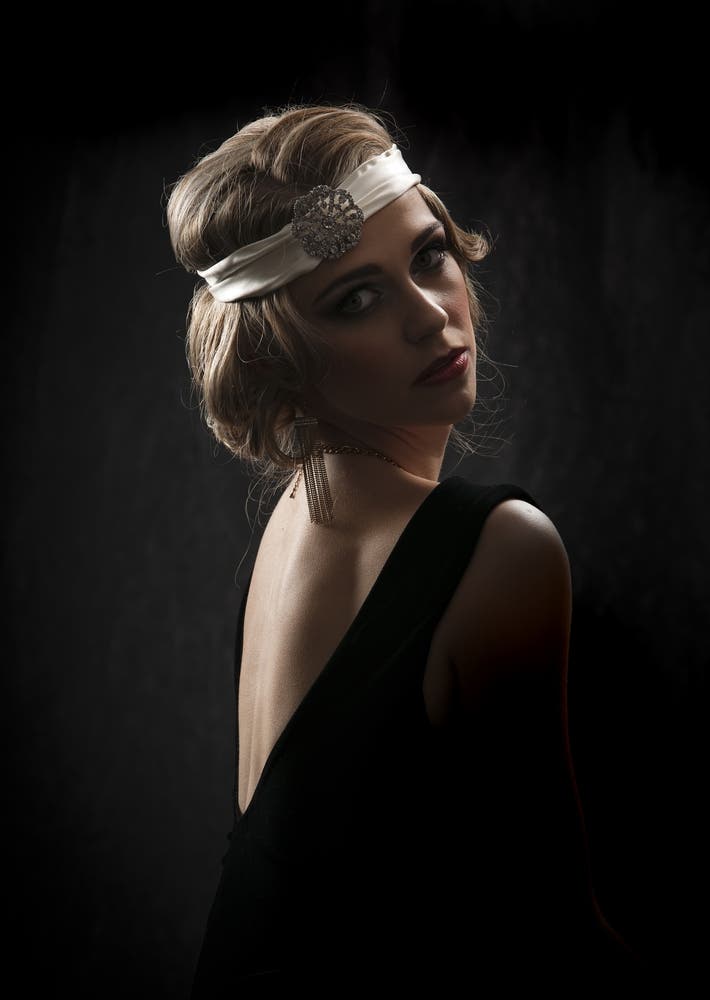
High Key and Low Key photography make use of lighting and contrast (or lack thereof) to create a specific mood. Originally high key photography emerged as a solution for screens that could not correctly display high contrast ratios. Today capturing high key photos, like low key photos, is a stylistic choice in photography.

Image result for high key and low key photography


Wednesday, 13 November 2019

Health and Safety

Health and Safety 

Professional film crews take health and safety issues very seriously. The line of responsibility runs from the Producer to the Production Manager and 1st Assistant Director and finally on to all crew members who have a duty of care which is recognised by law. If someone can see the potential for an accident and does nothing to try to prevent it, they can be held responsible in some way, probably along with their senior colleagues.
When filming, people have many things on their minds, things can get rushed, and risks can increase. Even simple things can become dangerous because this is not an ordinary situation. Of course, all of life presents hazards, but if someone is asked to run down a hill repeatedly to get the scene right, for example, the risk of them tripping and falling on their face is increased with each time they do this. If the hill is pavement rather than grass the risk of serious injury is increased.
Risk assessment
The way to stay safe is to look at each shooting set up or location individually and think of what exactly could go wrong. This is called a risk assessment, and can be an excellent exercise to do with your students. (if you don't work with the young people on it you will need to cover it yourself)

It's a three step process

  • Identify all the hazards
  • Evaluate the risks
  • Identify measures to control the risks
Then put in place safeguards to eliminate or minimise risk. You should make a record of any risk assessment to ensure the students are clear on how to stay safe. This can save time during your shoot. Rules about listening to each other, respecting a chain of command, looking after equipment properly, and not rushing, will all help to keep people safe and happy.
Weather
Day-to-day Benefits of Weather Detection
Extremes of weather are one commonly overlooked hazard. If you are filming outside all day, it is essential to make sure the crew are dressed appropriately. A lot of the time you may be standing around and people will get cold very quickly even in what seems quite mild weather. Layers of clothes are best, and get everyone to bring a waterproof and a woolly hat - they keep out wind as well as rain and are invaluable.
Sunburn and heatstroke are other outdoor hazards. Always have high protection sunscreen on hand and make the students put it on. Try to get students to wear some kind of sun hat or stay in the shade when possible and make sure lots of water is available to drink. The other reason for sunscreen is to stop the actors' appearance changing drastically and messing up the continuity of the film!
Wall clock TOBIAS D41cm silent movementTime pressureRushing to finish in time is when hazards get missed, or people start taking risks. If this starts to happen, take a moment to calm everyone down and remind them: this is only a film. If you feel really pressured try to think of how to lighten the work-load: can you cut out some shots or set ups to give you the time to get the most essential stuff for the film without a panic? Or can you come back tomorrow to finish?
Image result for tripping over wires images

Common hazards

Tripping hazards

Move or gaffa tape down cables and objects that could be tripped over. 

Lifting hazards 
Go carefully when moving or lifting heavy or dangerous things, ask someone to help you.

Camera risks

When a camera operator or cast member is walking during a shot, make sure they are comfortable with their route and there is nothing that could cause problems (a camera operator who needs to walk backwards for a shot should have an assistant to guide them and/or check their route).
Water
Shots that involve water  
film and water

Precarious

Shots from high up or near the edge of something.Shots that look illegal
Retro photo camera on a ledge Free Photo

Shots that look illegal 
Shots might look illegal if you didn't know a camera was there. This could cause distress to members of the public &/or cause a police call out.  


weather image - https://www.vaisala.com/en/blog/2019-07/day-day-benefits-weather-detection

Thursday, 10 October 2019

1920's Style Film


For this film challenge we were tasked with making a 2 minute 20's style film. We decided that a horror/mystery sense would be the best theme to go with to get the era across. 

Our original plan was to go to the top of the old college in the abandoned attic to film a series of shots. However for health and safety reasons we were not allowed to be up there. Because of this we went with the style of a 'Benny Hill chase' which although was ahead of the time period we were set in, actually worked quite well and led us to featuring different motion shots that we may not have had with our original idea. 

Another element of this challenge was the fact it was a silent film that we had to subtitle in editing, this was new to us as we had normally featured the audio from the original shot which meant we had to think more about how the actors were presenting themselves visually to make sure the narrative would match up through filming and editing.

A problem we had when filming was the camera was running low on battery so we had to film quicker than we'd have liked which meant some of the shots we had were not as polished as we needed meaning we had to go and re-film some shots as they were out of focus. This was obviously an inconvenience as it was taking away from the editing time we had set for ourselves. 

One of the reasons we were tasked with a 1920's silent film was to work with adding layers on film, we were given a 'scratchy' effect to place over the footage to really emulate that old footage look to pass it off as a 1920's original film, with this we still had to play around with how transparent we wanted it to appear to ensure the original footage was still visible. In addition to this were featuring text to caption the scenes taking place with speech that we individually decided we wanted. Finally it was to add the music which was relatively simple however still had to be timed right to suggest an organised flow to the film. 

Tuesday, 24 September 2019

Camera Research (shutter speed etc)

Shutter Speed 
Controls how long your camera's sensor is exposed to the light and is responsible for the motion appearance within photos. "An easy way to understand shutter speed is to liken it to your eyelids. For example, if you shut your eyes, then open them for 1/2 second without blinking, then shut them again, you've essentially created a 1/2 second exposure for your eyes. That is, for that 1/2 second, light was able to pass through to your retinas." 
Shutter speed is most commonly measured in fractions of a second, like 1/200 seconds or 1/1000 seconds. Some high-end cameras offer shutter speeds as fast as 1/8000 seconds.   
For motion in an image, the required shutter speed would need to be faster than the motion occurring. Also important is the direction of the camera in relation to the motion as that can alter the required shutter speed.                     
                                   ISO
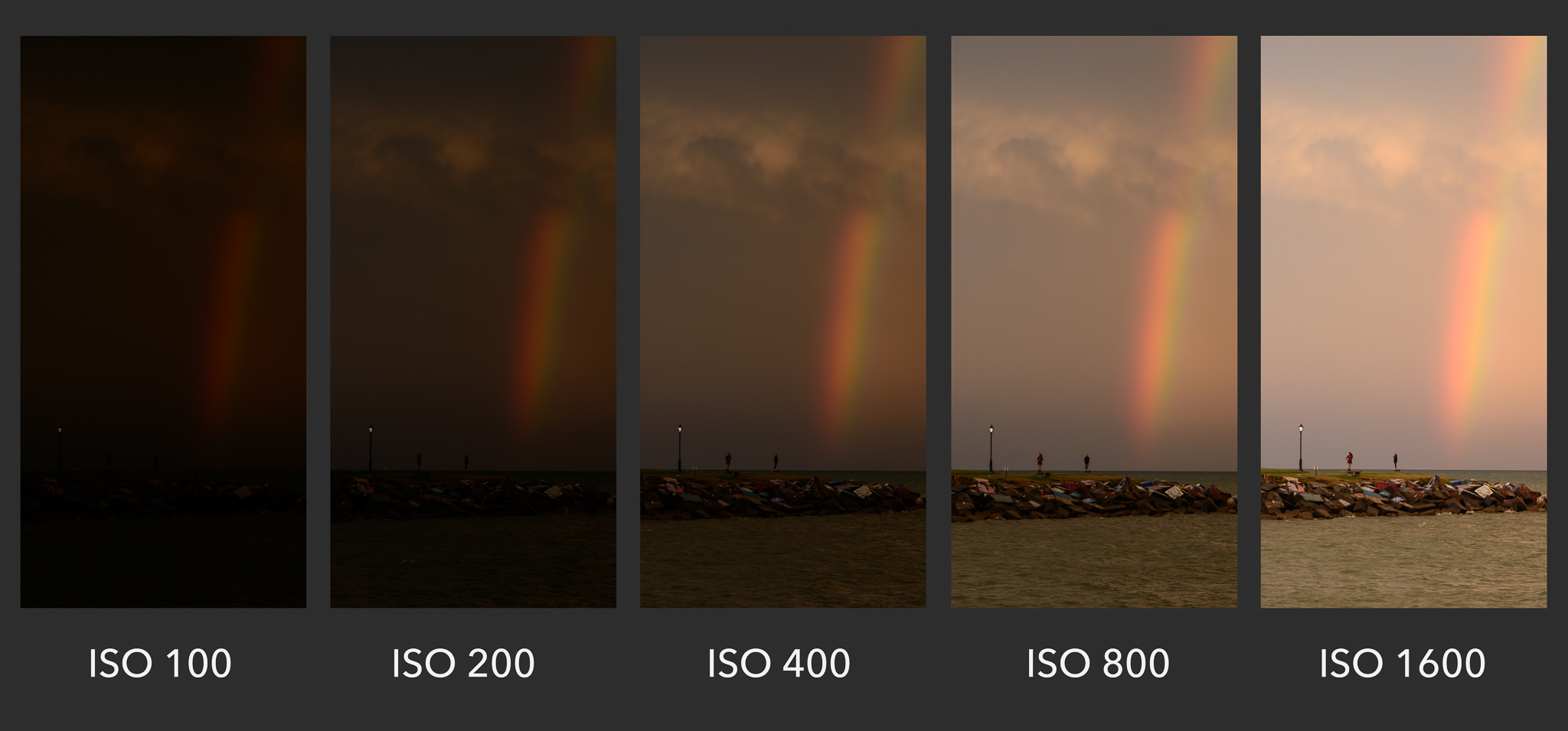
Determines how sensitive your camera is to light whilst also being responsible for how much digital noise appears in an image,(more simply a setting that will brighten or darken a photo). ISO increased helps capture shots in darker environments but can also lead to a high concentration of 'noise'. 
A common ISO set: 
ISO 100 (low)                    
ISO 200
Aperture Effect on BrightnessISO 400
ISO 800
ISO 1600
ISO 3200
ISO 6400 (high)

Aperture 
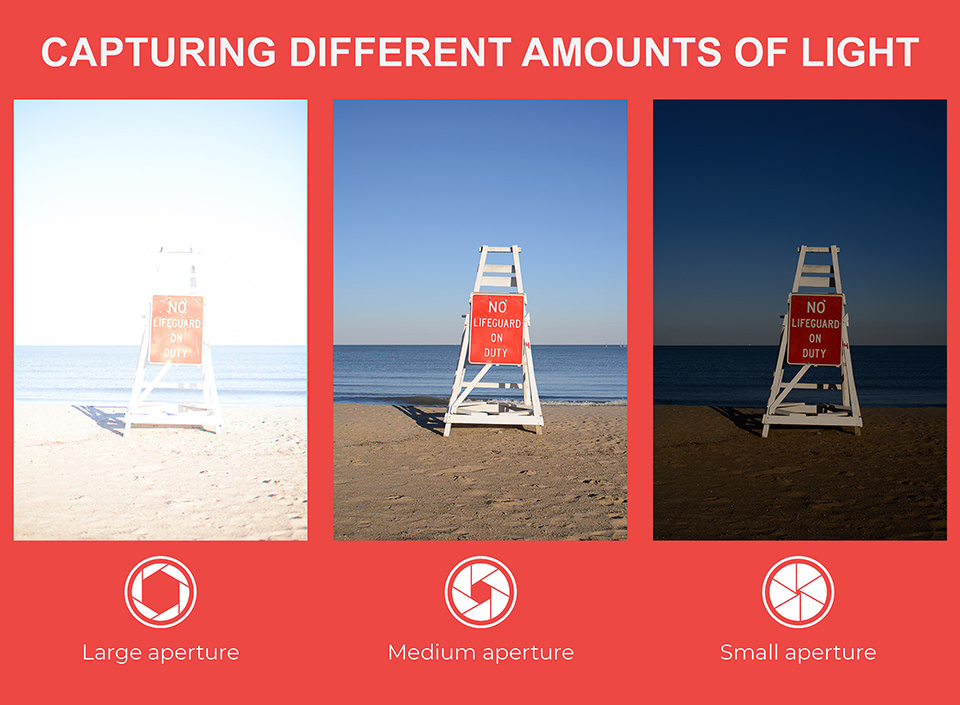
Controls the amount of light entering a lens and is responsible for depth of field or the extent of the image that's in sharp focus. Again the comparison of the human eye is the simplest explanation, like the pupil of a human eye, the lens can expand or shrink depending on the exposure to light. 

Depth of field:
Depth of field is the amount of your photograph that appears sharp from front to back. Images can vary between having shallow depth of field (out of focus background) or deep depth of field (sharp foreground and background). Categorised further as large and small
depth of field often plays a key part in a image where you want your subject isolated or where you want every bit of detail captured respectively.
Depth of field comparison between an image captured at f/4 vs f/32 apertures

Frame Rate
The number of individual frames that comprise each second of a video also known as FPS (frames per second). Frame rate can impact the style and viewing of a video, differing frame rates result in different viewing experiences. It controls how realistic your video appears (if you choose a frame rate too high, it will appear unnatural and will be hindered by the description of the "soap opera effect" a frame rate too low will appear "choppy" and provide a poor experience) or whether you use additional techniques in editing.
For example, movies are usually displayed at 24fps, since this frame rate is similar to how we see the world, and creates a very cinematic look. Video that’s broadcast live or video with a lot of motion, such as a sporting event or video game recording, will often have a higher frame rate, as there’s a lot happening at once and a higher frame rate keeps the motion smooth and the details crisp.                                                 
24fps
This is the standard for movies and TV shows, and it was determined to be the minimum speed needed to capture video while still maintaining realistic motion. Even if a film is shot at a higher frame rate, it’s often produced and displayed at 24fps. Most feature films and TV shows are shot and viewed at 24 fps.
30fps
This has been the standard for television since the early days, and is still widely used despite producers moving toward a more cinematic 24fps. Videos with a lot of motion, such as sports, will often benefit from the extra frames per second. The reasons for using 30fps is strangely complicated and it mainly has to do with television and electricity standards set a long time ago. If you want learn more, check out this article on frame rate and jump down to the section titled “modern video standards.”
60fps                                                                            Anything over 30fps is typically used for slow motion purposes or the recoding of game footage.


Pull Focus 

Pull focus is a camera technique in which you can change the focus of a camera during a shot, this usually involves shifting the focus from one subject to another. 

The focus pull is useful for directing the viewer's attention. For example, if there are two people in shot but only one is in focus, that person is the subject of attention. If the focus changes to the other person, they become the subject. This is often used in drama dialogues — the focus shifts backwards and forwards between the people speaking. A slightly more subtle trick is to focus on a person speaking then pull focus to another person's silent reaction.

https://www.photographytalk.com/beginner-photography-tips/shutter-speed-explained  

https://photographylife.com/what-is-iso-in-photography

https://photographylife.com/what-is-aperture-in-photography

https://www.techsmith.com/blog/frame-rate-beginners-guide/

https://www.mediacollege.com/video/camera/focus/pull.html

New wave essay